
Social Proof Aggregation: Why It Increases Conversions and How to Set It Up
Your customers are already reviewing your products on Google, tagging your brand on Instagram, and posting unboxing videos on TikTok. That content influences buying decisions more than most marketing copy—but it usually lives scattered across platforms, hard to reuse on your website.
Social proof aggregation solves that problem. It collects customer content from multiple channels, lets you moderate what appears, and displays it as a live feed on your site. This guide explains why social proof increases conversions, what makes aggregation different from manual embeds, where it belongs on your website, and how to set it up with SocialMatix.
Why social proof increases conversions
People look to others’ experiences before they buy. Online, that means reviews, customer photos, and testimonials directly influence whether someone clicks “Buy,” books a demo, or fills out a form.
Reviews consistently rank among the top factors shoppers consider before purchasing—often behind only pricing and product images. Format matters too. Customer photos and videos carry more weight because they feel harder to fake, and video testimonials often outperform text-only reviews when shoppers want to see a product in real use.
Placement is just as important as the content itself. A carousel of customer photos on a product page or homepage does more than a testimonial buried on a separate “Reviews” page. Social proof placed near calls to action, signup forms, and pricing sections reduces hesitation and improves conversion rates.
For ecommerce, the strongest impact usually shows up on product pages, landing pages, and checkout screens. For agencies and multi-brand teams, the same principle applies: trust signals work best when they appear consistently near decision points across every important surface.
What makes social proof aggregation different
Most brands start with the basics. They copy a customer quote into a testimonial section or screenshot a positive review and upload it as an image. That works when you have five reviews. It stops working when customers are posting across Instagram, TikTok, Google, and YouTube every week.
Social proof aggregation solves the scale problem. Instead of manually collecting content from each platform, an aggregation tool connects to multiple social networks and review sources, pulls content into one place, and lets your team moderate, organize, and display it.
This approach works better than manual collection or native embeds for three reasons:
-
Multi-platform in one feed. Native embeds are limited to one platform at a time. An Instagram embed shows only Instagram posts; a Google Reviews widget shows only Google Reviews. With aggregation, you can combine Instagram photos, Google Reviews, TikTok videos, YouTube content, and more into a single social wall.
-
Moderation and brand control. Native embeds give you almost no control over what appears. If someone tags your brand in an off-topic or inappropriate post, it can show up on your website. Aggregation tools let you approve, hide, or filter content before it goes live.
-
Less technical maintenance. Each platform has its own authentication, rate limits, and API changes. An aggregation tool handles those connections behind the scenes. Your team connects sources once and focuses on strategy instead of rebuilding integrations every time a platform changes.
For marketing teams, that means less time on content operations and more time on campaigns. For agencies, it means a repeatable way to deliver social proof across client sites without custom development for every project.
Where social proof belongs on your website
Where you place social proof determines its impact. These placements work especially well:
-
Product and service pages. Customer photos, reviews, and tagged posts next to product descriptions help shoppers make confident decisions. Place social proof near pricing, add-to-cart buttons, or booking forms.
-
Homepage. A social media wall combining customer Instagram posts, Google Reviews, and brand content gives first-time visitors an immediate sense of credibility.
-
Landing pages. Campaign-specific social proof—such as posts tagged with an event or product-launch hashtag—validates your messaging with real customer voices. Keep this content fresh so landing pages stay credible.
-
Checkout and conversion pages. Showing recent reviews or customer photos near checkout or signup reduces last-minute hesitation, especially for higher-priced products or services.
-
Event screens and digital displays. Retail stores, hotel lobbies, conference venues, and campus buildings can display a live social proof feed on any browser-connected screen. Content refreshes automatically on your plan schedule.
How to set up social proof aggregation with SocialMatix
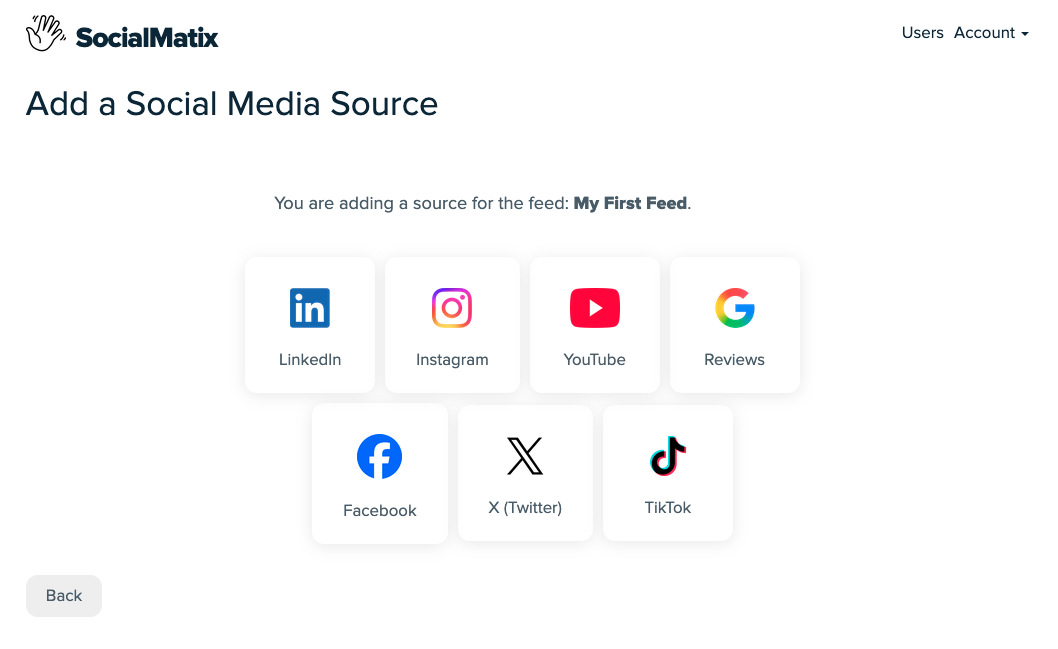
SocialMatix is a social media aggregator that collects content from Instagram, YouTube, Facebook, X (Twitter), TikTok, LinkedIn, and Google Reviews, then lets you embed a moderated feed on any website with a single code snippet.
Step 1: Create your account and feed
Sign up for a free SocialMatix account—no credit card required.
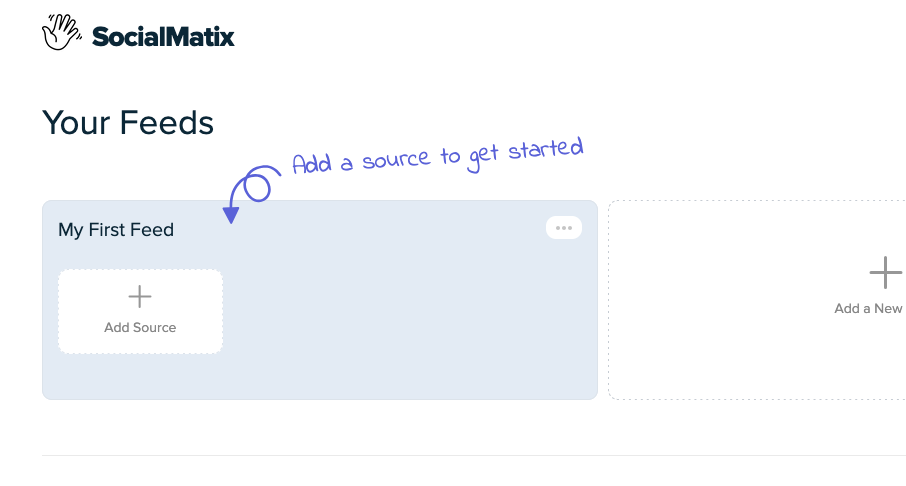
Create a new feed for the website, campaign, or client project where you want social proof to appear.
Step 2: Connect your social proof sources
-
Click Add Source and connect the channels your customers already use—Instagram accounts or hashtags, Facebook Pages, YouTube channels, TikTok, LinkedIn, X, or Google Reviews venues.
-
Mix sources in one feed when you want richer social proof. For example, combine Instagram UGC with Google Reviews on a product or location page.
Step 3: Moderate what appears
Review imported posts and hide anything off-brand before you publish.
-
On paid plans, use post moderation, editing, and pinning so your strongest reviews and customer photos stay visible near decision points.
Step 4: Customize the layout
-
Choose a layout that fits the page—grid, image grid, carousel, hopscotch, or list—and match colors and spacing to your brand.

Keep the design intentional so the feed feels native to the page, not bolted on.
Step 5: Publish and embed
Click Publish and copy the embed snippet.
-
Paste it into your website builder or CMS—for example a Custom HTML block on WordPress or a Code block on Squarespace.

Preview on desktop and mobile, then publish. Your feed will update automatically as new approved content arrives.
The free plan includes 3 sources, up to 1,000 posts, daily content refresh, and 2,000 views per month—enough to launch social proof on a live page before scaling to Growth or Business for faster refresh and advanced moderation.
Related guides
Frequently asked questions
What is social proof aggregation?
Social proof aggregation is the process of collecting customer content—reviews, social posts, photos, and videos—from multiple platforms into one moderated feed you can display on a website, landing page, or screen.
How is aggregation different from a native Instagram or Google embed?
Native embeds usually show one platform at a time and offer limited moderation. Aggregation combines multiple sources in one feed, gives you control over what appears, and updates automatically without manual screenshots or CMS updates.
Where should I place social proof on my website?
Place it near decision points: product pages, homepage, campaign landing pages, checkout or signup flows, and event screens. Social proof works best when visitors see it at the moment they are deciding whether to trust you.
Can I mix Google Reviews with Instagram or TikTok in one feed?
Yes. SocialMatix feeds can include multiple source types in a single embed, so you can show star ratings alongside visual UGC on the same page.
Do I need a developer to set up social proof aggregation?
No. With SocialMatix, you connect sources, customize the layout, and paste an embed snippet into your CMS. No custom API integration is required for standard website embeds.
Is social proof aggregation available on the free plan?
Yes. You can start on the SocialMatix free plan with 3 sources, up to 1,000 posts, daily refresh, and 2,000 views per month. Upgrade when you need faster refresh, post moderation tools, or higher view limits.
How often does the social proof feed update?
Updates follow your plan schedule—daily on Free, hourly on Growth ($24/month), and every 15 minutes on Business ($50/month). You do not need to re-paste the embed code when new content is imported.
Can agencies use this for multiple client websites?
Yes. Create separate feeds per client or campaign, moderate content to match each brand, and embed each feed on the relevant site. Unlimited team members are included on all SocialMatix plans.
Final takeaway
Social proof increases conversions because people trust other customers more than brand claims. Aggregation makes that proof scalable: collect content from multiple platforms, moderate it, and place it where decisions happen.
Ready to add social proof to your website? Create a free SocialMatix account and embed your first feed in minutes.