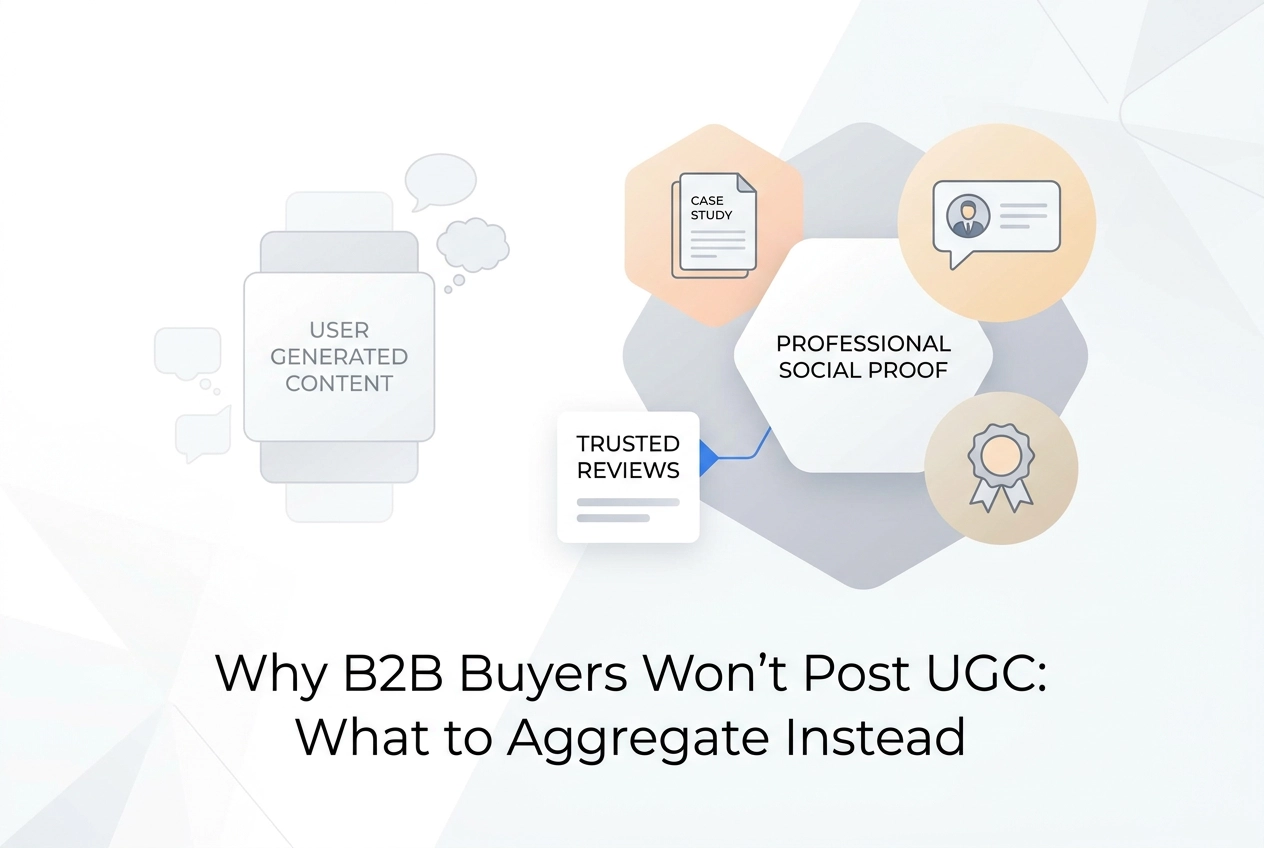
B2B buyers rarely photograph a product and post it online, which is why the standard consumer playbook for user generated content marketing falls short in a business context. The assumption that social proof must look like a customer selfie or an unboxing video leaves a significant gap in the evidence available to prospects who prefer a rep-free buying experience.
This analysis breaks down why the consumer model fails and what to aggregate instead. You will learn how to replace customer photos with sources that actually supply proof: LinkedIn commentary from buyers and practitioners, structured quotes from review platforms, conference and event posts, partner and reseller content, and employee advocacy. We will also cover the practical mechanics of getting consent at scale without killing the program, and why review and employee content often outperforms customer posts across long sales cycles.
The post concludes with a concrete plan for turning aggregated proof into a live website feed and outlines what to do this quarter. If your current strategy relies on waiting for customers to generate content, this guide provides the alternative sources and operational steps you need to build a credible, compliant feed of real-world evidence.
What Counts as User Generated Content in Marketing
User-generated content (also written user generated content) is anything a customer, employee, partner or fan creates about a brand without being paid to make an ad, from a LinkedIn comment to a review to a conference photo. For a fuller definition, see what counts as user-generated content?. User generated content marketing was built on chasing unboxing photos, tagged Instagram posts and TikTok product videos, then reposting the best into a social wall as cheap, independent-looking proof. B2B teams copied that format without checking whether the raw material exists.
This is my argument, not a researched finding: in B2B there is rarely a photogenic product and the buyer is often not the end user, so proof has to be assembled from where buyers actually talk instead of from customer posts. This section gives one tight definition for the broad query, then the B2B translation for the rest of the page.
Why the B2B UGC Playbook Falls Apart
The consumer playbook's two assumptions, a photographable product and a buyer willing to post, rarely hold in B2B, and an internal champion signing a contract may never touch the product daily.
Sales cycles compound it: months of evaluation, multiple stakeholders and repeat approvals mean one customer photo cannot carry the proof load. Each buying-committee layer needs different evidence; one Instagram-style post rarely survives round two.
Individual customers are constrained too: a champion may be under NDA, lack marketing control or permission to speak publicly. Asking for content quietly fails.
Buyers research without a rep: a Gartner release dated 9 March 2026 reports 67% of B2B buyers prefer a rep-free experience, headline-only, with no sample size or methodology in summary. Reading it as a case for on-site social proof is our inference, not Gartner-measured. Yet buyers still want human confirmation: a Gartner release dated 20 May 2026 reports 69% of B2B buyers turn to sales reps to validate AI-generated insights. So social proof visitors actually believe must show identifiable people, not only brand claims.
If buyers self-serve but still check for humans, the job is not customer photos but visible evidence from named people.
What to Aggregate Instead of Customer Photos
Start by selecting sources on trust, not embed convenience. At each stage of a long B2B cycle, ask whose voice the buyer will accept. Favour named authorship over logos: a post from a named practitioner, a dated review from a named company, or an employee post carries more weight than an anonymous wall. Each of those five sources is detailed in the sections that follow. Curate hard. A tightly curated set outperforms a large volume of low-signal posts, because buyers scan for the one item that matches their situation. Apply a committee filter: every item should answer a question the buying group actually asks, such as security review, implementation effort, or post-purchase support. This selection logic is the core of what makes social proof aggregation different, and it sets up the source-by-source detail that follows.
LinkedIn Commentary From Buyers and Practitioners
The same named-authorship test applies on LinkedIn. Capture posts where customers, champions and prospects describe the problem in their own words; evaluation language persuades where marketing copy does not. Make collection routine by monitoring brand mentions, campaign hashtags and customer hashtags, so you are not hunting screenshots after a deal closes. Turn the strongest posts into quote cards with name, role and company context, then ask the author for permission to embed the original post where platform terms allow. In long cycles this matters: a peer comment gives a sceptical middle layer stage-appropriate evidence before they want to speak to a rep. Set boundaries. No private group content, no screenshot without permission, and no trimming a quote until it implies something the author did not say, since alterations that do not fairly reflect a review's substance conflict with FTC endorsement guidance. These quotes work best beside client testimonials and social proof signals, not as a substitute for them.
Review Platform Quotes as Structured Proof
LinkedIn gives you peer language; review platforms give you structure. Most B2B review listings carry a date, a named reviewer, role, company size and industry, which is exactly the profile data a buying committee uses to map proof onto its own situation. Filter for reviewers who resemble your ideal customer: a mid-market operations lead should see proof from another mid-market operations lead, not an enterprise outlier. Display a small rotating set of quotes with rating, date and role visible, link to the source review where permitted, and check what visitors will see when you embed it. Keep every quote verbatim. Paraphrasing a review to sound more enthusiastic destroys credibility, and editing carries legal risk. Before making any claim about what is permitted for reviews, testimonials, social posts or consent, read the FTC's Questions and Answers page on the Consumer Reviews and Testimonials Rule in full.
Conference and Event Posts
Where review quotes supply structured proof, event posts supply visible presence. Booth photos, session talks, panel seats and hallway conversations read as activity rather than advertising, because real people, real venues and real momentum are difficult to stage at scale.
The collection problem is solved before the event. Ask speakers, attendees and partners to use one consistent hashtag, so the content becomes aggregatable afterwards instead of scattered across accounts.
Reuse matters. Long sales cycles have quiet months between events, so rotate past-event posts into your social proof blocks rather than letting the block go stale.
Event proof also works as a fit signal. Buyers who attend the same industry events as your team share context already, and seeing you there shortens the trust gap.
Permission is the constraint. Event photos often include people who did not agree to appear on your site. Get clearance from the organiser, the photographer and anyone identifiable before publishing.
Partner and Reseller Content
Partner content also inherits a credibility that your own posts cannot match. Implementation partners and resellers publish walkthroughs, integration notes and joint webinars, and a partner has no obvious reason to flatter you. Aggregate partner handles alongside a shared campaign hashtag so those posts sit with customer and employee content in one feed. Use them to answer the technical and risk questions a buying committee raises late, such as how implementation actually runs and who supports the account after go-live. Handle consent at the contract stage, with a co-marketing clause covering logos, quotes and social posts, because asking after publication is always harder.
Employee Advocacy and Expert Posts
Your own people can supply a complementary human signal. Engineers, customer success managers and account leads are named practitioners, and their posts about shipping a feature, running an onboarding or attending an industry event deliver the confirmation buyers seek when validating what they have already read.
Turning Experts Into a Content Pipeline
An employee advocacy programme gives you a steady supply of posts already governed by a company social media policy. Confirm that policy actually grants reuse rights for website publication before you display anything.
Attribution must stay explicit. Label posts as employee commentary so they are never mistaken for customer voice. Presenting staff content as a customer testimonial is both a credibility risk and a regulatory one, given the FTC's Consumer Reviews and Testimonials Rule treats undisclosed insider testimonials as violations.
Balance the feed. Mix employee expertise with review quotes and partner content so the block reads as a rounded body of proof, not a company feed in disguise. This blend also keeps social proof on key pages fresh, as why social proof on a portfolio beats static work samples alone explains.
Getting Consent at Scale Without Killing the Programme
Employee posts only become reusable proof once consent is as routine as publishing. Capture permission at the point of interaction, not months later: review submission forms, event registrations, partner onboarding and customer onboarding are natural places to request a broad, written, ongoing licence to reuse content.
Keep one asset register recording creator, source, date, agreed scope, display locations and expiry. A single spreadsheet beats searching old inboxes before a legal review.
Make opt-out easy and act quickly. A working takedown process matters more than a perfect form, because people change their minds.
Follow each platform's embed rules and keep the author's attribution visible.
Before writing policy claims, confirm the FTC Q&A scope before publishing, as noted above, to confirm whether it covers social posts or only reviews and testimonials; keep statements within that scope.
Why Review and Employee Content Often Outperforms Customer Posts Over Long Cycles
With consent handled, the next question is which formats deserve the space. This is the author's argument, not a measured finding: the research set contains no study comparing review platforms, employee advocacy, LinkedIn commentary and customer posts.
The long-cycle case rests on availability. Buyers re-enter evaluation as stakeholders change and budgets are re-approved. Evergreen review quotes and employee expertise are present at every re-entry, while a single customer post has one moment.
Review content's structured profile data (role, company size, date) maps directly onto committee questions already explored above.
Named employee posts carry the accountability that satisfies the human-confirmation appetite the May 2026 Gartner headline signals.
Customer posts still matter at the reference stage: they work best as a deep story a reader can click into, not as the front line of on-page proof.
Turning Aggregated Proof Into a Live Website Feed
That reference-stage story still needs a home. Aggregating proof once leaves you with a folder of assets that decays as dates, roles and campaigns move on. A live feed makes the process continuous: new reviews, event posts and employee content surface without a quarterly rebuild. SocialMatix merges Facebook, Instagram, YouTube and TikTok, plus multiple accounts, hashtags and content types, into one designed feed. Every item passes through moderation before it appears, and the feed updates automatically once live. Moderation is also where consent, freshness and off-brand content get handled in one place, which matters when you are pulling from five sources with different rules. Place the feed where hesitation happens: pricing, security and integration pages, customer story pages, or a band beneath the homepage hero, not a footer strip. SocialMatix suits small businesses through to large corporations, and is particularly useful for agencies managing feeds on behalf of multiple clients.
Conclusion: What to Do This Quarter
A live feed only compounds if there is steady, consented supply behind it. So this quarter, accept the premise: stop chasing customer photos. In most B2B categories the raw material for a consumer-style user-generated content programme does not exist, and waiting for it costs months.
Start with two sources, not five. Review-platform quotes and employee advocacy usually produce consented inventory fastest because the permission conversation sits inside an existing review or social media process. Build the consent register before publishing anything. Confirm the FTC Q&A scope before publishing, as noted in the consent section above.
As established above, review and employee content are core proof; keep customer stories for the reference stage. Put the consented library into a moderated, automatically updating feed, and the proof block grows without another project.