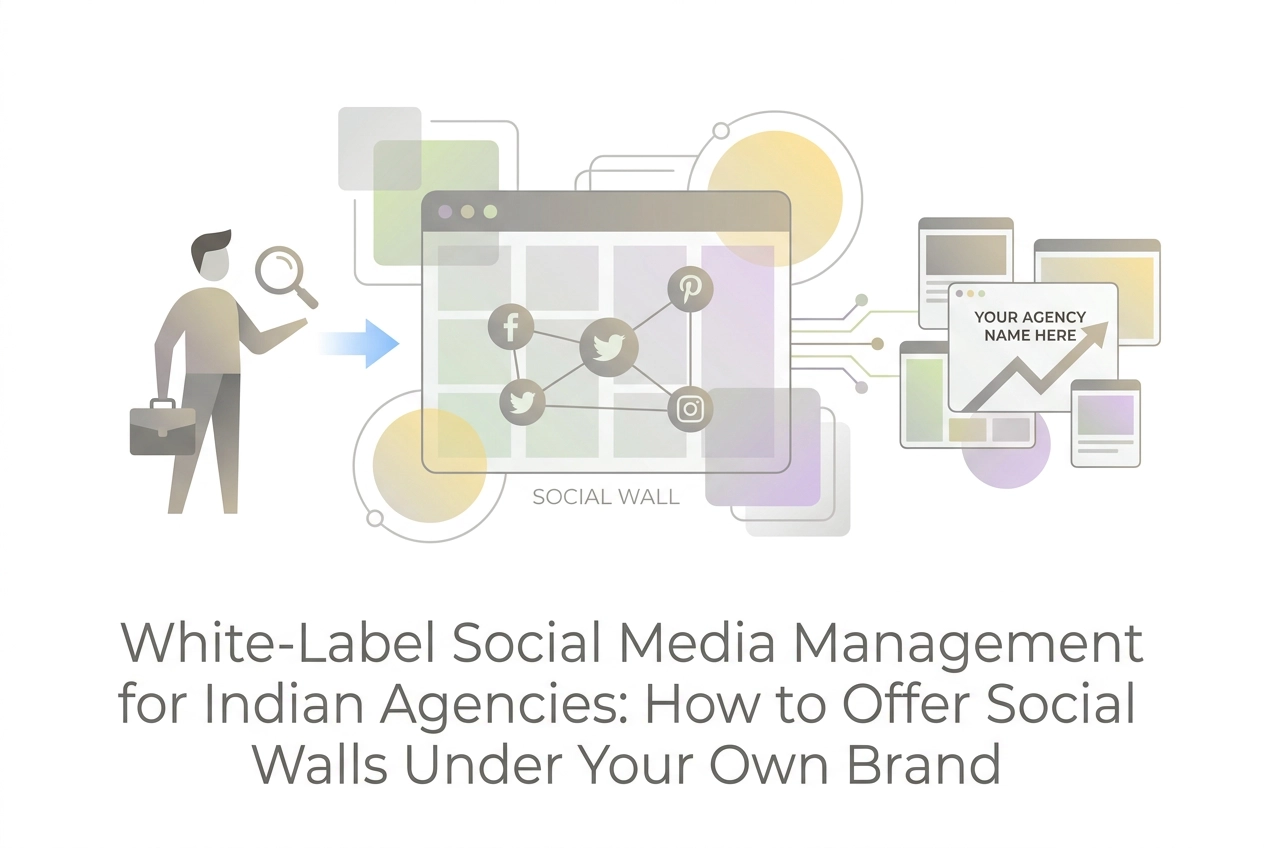
Most Indian agency owners are already familiar with the white-label agency model, reselling SEO, PPC, or content services under their own brand. But there is a quieter opportunity sitting right in front of them that almost no one in the Indian market has claimed yet: branded social wall aggregation as a standalone, recurring-revenue product.
Think about what your clients actually want. They want their websites to feel alive, current, and connected to their social presence, without asking their developer to update anything manually. A white-label social media aggregator solves that problem elegantly, and it gives you something far more valuable than a one-time project fee. It gives you a reason to invoice the same client every single month.
This guide walks you through everything you need to launch this service confidently. You will learn why a social wall is a product line rather than a simple feature add-on, how to set it up under your own brand, how to price it for the Indian market, and how to pitch it to clients who are already trusting you with their digital presence. The recurring revenue potential is real, and the window to differentiate is open right now.
The White-Label Opportunity Indian Agencies Are Missing
Most marketing agencies now outsource at least some services to white-label partners, the model is standard practice, not an experiment.
Indian agencies have embraced this well in established categories. SEO reselling, PPC fulfilment, and content marketing outsourcing are all mature offerings with multiple domestic providers. Yet one category remains almost entirely unclaimed: branded social wall aggregation as a packaged, recurring revenue service.
Branded social wall aggregation as a packaged, recurring-revenue service remains a largely unclaimed space in the Indian agency market, which is precisely what makes it worth moving on now.
The revenue case is straightforward. If you bill even 20 clients a modest monthly retainer, the MRR arithmetic becomes compelling fast, without any in-house content production. The agency does not create posts; it aggregates and displays content the client is already publishing.
That distinction matters when you compare it to traditional project work. A website build fee is recognised once and never again. A social wall subscription renews every month, compounds across your client base, and grows more valuable as more clients onboard. For agencies looking to move beyond lumpy project income, this is what a sustainable revenue product looks like.
For a broader view of how this translates across different client types, 10 ways digital marketing agencies can use social walls to win clients is worth reviewing before you build your service proposition.
Why a Social Wall Is a Product Line, Not a Website Feature
Understanding why a social wall commands a monthly retainer starts with understanding what it actually is.
A social wall pulls live content from Facebook, Instagram, YouTube, TikTok, and other channels into a single moderated feed embedded on a client's website. It is not a static banner or a one-time build deliverable. Every post the client publishes, and every piece of relevant user-generated content tagged to their brand, flows through automatically.
That auto-updating behaviour is the commercial engine. The feed is never finished, which means the value delivered is continuous. When a client sees their Instagram Reels and YouTube Shorts appearing on their homepage without lifting a finger, they are experiencing the service working. That ongoing, visible output makes monthly billing intuitive to justify.
The UGC dimension strengthens the case further. User-generated content displayed through social aggregation supports events and live activations as well as everyday conversion goals, acting as persistent social proof that clients in retail, hospitality, and services already value.
Positioning this as a managed, branded service separates it from free widget alternatives. Free embeds exist; managed moderation, channel strategy, and branded delivery do not. Clients pay for curation, reliability, and expertise.
The white-label layer completes the model. When the tool operates under your agency's branding, clients associate the ongoing value with you, not with any underlying platform. That association deepens retention and reduces the motivation to cancel.
What You Need Before You Launch This Service
Before you sell this service, five components need to be in place.
1. The right platform. You need a white-label social media aggregator that supports custom branding, pulls from multiple channels (Facebook, Instagram, YouTube, TikTok), and includes content moderation controls. SocialMatix is built specifically for this agency use case, handling multi-channel feeds and embed functionality under your brand. Check the Frequently asked questions to confirm which source types and branding options are available before you build your pricing.
2. A defined service tier structure. Document exactly what each plan includes: number of channels connected, number of sources per channel, moderation frequency (weekly versus daily), and reporting cadence. Vague scope leads to scope creep. Concrete tiers make the service sellable and deliverable.
3. Branded client-facing assets. Prepare a one-page service overview, an onboarding email sequence (three to four emails covering setup, go-live, and first check-in), and a reporting view that carries your agency's logo. Clients should never see the underlying platform name.
4. INR-denominated recurring billing. Configure subscription invoicing in your existing accounting tool or a standalone platform that supports monthly billing in rupees. Recurring invoices should trigger automatically, not manually.
5. A client intake form. A short form capturing social handles, preferred channels, content types to include or exclude, and moderation preferences cuts setup time significantly and sets clear expectations from day one.
How to Set Up and Deliver a Branded Social Wall Service
With your prerequisites in place, here is how to move from setup to a live, billable service.
Step 1: Configure your white-label account. Inside SocialMatix, apply your agency logo, brand colours, and a custom domain or subdomain. Once this is done, every client-facing touchpoint reflects your agency, not the underlying platform.
Step 2: Build the client's feed. Connect the client's social accounts and any relevant hashtags across channels such as Instagram, Facebook, YouTube, and TikTok. Set moderation rules to filter out off-brand or irrelevant content, then choose a display layout that matches the client's website aesthetic.
Step 3: Embed and test. Generate the embed code from SocialMatix and place it on the client's website. Test on mobile, tablet, and desktop to confirm responsive display, and verify that the feed refreshes automatically so no manual updates are ever needed.
Step 4: Hand off with a branded walkthrough. Record a short screen walkthrough or run a brief live demo showing the client their finished social wall. Frame it clearly: this is a managed service your agency maintains, not a tool they need to learn or operate.
Step 5: Set a monthly check-in rhythm. Schedule a short monthly review to refresh moderation rules, connect new channels as the client's social presence grows, and show feed activity. This touchpoint is what turns a one-time setup into a defensible subscription. For a practical checklist covering each of these stages, the final takeaway is worth bookmarking before your first client goes live.
Pricing Your Social Wall Service for the Indian Market
With your service delivery process in place, the next decision is what to charge.
The following tier structure is illustrative; you should validate rates against your local competitive set and client budgets.
Tier | Price | Includes |
|---|---|---|
Starter | ₹5,000/month | 2 channels, basic moderation |
Growth | ₹8,000/month | 4 channels, weekly moderation review |
Premium | ₹15,000/month | All channels, daily moderation, monthly performance report |
Most clients will default to the Growth tier. For example, at ₹8,000/month (a mid-tier illustrative rate), 10 clients generates ₹80,000/month in recurring revenue; 25 clients returns ₹2,00,000/month from a single service line with minimal fulfilment overhead.
The margin picture improves as you grow. Your SocialMatix subscription is a fixed or tiered platform cost, not a per-client charge. Adding your fifteenth client costs you no more in platform fees than your fifth, so gross margin expands with every new account you onboard.
The lowest-friction route to your first sales is bundling. Add the social wall as a line item to existing website maintenance or social media management retainers rather than pitching it as a standalone product. Clients already paying a monthly retainer are primed for add-ons; there is no new contract to negotiate and no new vendor relationship to justify. If you have questions about specific platform integrations before pricing a client, the frequently asked questions resource covers common setup scenarios that affect scoping decisions.
White-Label Social Wall vs. Building Your Own: An Honest Comparison
Once your pricing tiers are defined, most agency owners ask whether a custom solution would be more cost-effective long-term. The short answer is almost never, and the numbers explain why.
A custom multi-channel aggregator requires separate API integrations for each platform: Facebook Graph API, Instagram Basic Display API, YouTube Data API, and TikTok API. Each carries its own authentication flow, rate limits, and versioning policy. Managing four live integrations simultaneously is a substantial ongoing engineering commitment, not a one-time build.
Platform API changes make this worse. Meta, Google, and TikTok deprecate API versions on their own schedules with little notice. When a breaking change ships, your custom feed goes dark until a developer patches it. Those emergency hours are unplanned, unbudgeted, and unbillable. A white-label SaaS absorbs all platform-level updates internally, so your agency never carries that burden.
The cost gap is significant. Custom development for a comparable multi-channel aggregator in India carries a significant upfront cost, typically well into the lakhs, plus an ongoing developer retainer. A SaaS subscription is a flat, predictable monthly cost that scales with your client base, not engineering complexity. Moderation tools, layout customisation, and embed functionality come standard in a white-label platform like SocialMatix, with no separate development required.
A white-label setup can be completed in days once your account is configured; a custom build across four platform APIs can easily stretch across multiple months, while a competitor could already be billing clients for the same service.
How to Pitch Social Walls to Existing Clients and Keep Them Subscribed
Once the technical build question is settled, the real work is persuasion, getting existing clients to see the value and stay subscribed month after month.
Start with what they already own. The most effective opening line in any pitch is: "You are already producing content on Instagram and YouTube. A social wall puts that content to work on your website and keeps it fresh without any extra effort from your team." This reframes the conversation from "new cost" to "unlocking existing investment."
Connect it to outcomes they already care about. Websites with fresh, auto-updating content give visitors a reason to stay longer and return, an argument that resonates with any client already tracking bounce rate and time-on-site.
For e-commerce and hospitality clients specifically, lean on trust. Customer photo feeds and review aggregation are particularly compelling in these segments. A hotel or online retailer displaying real customer posts builds credibility far more effectively than any static banner. Position the social wall as a trust-building tool with proven marketing impact, not a decorative feature.
Once the feed becomes an established part of the client's website identity, removal is disruptive enough that most clients continue renewing, the service becomes infrastructure, not a discretionary line item.
Monthly reporting seals the managed-service positioning. A one-page summary showing feed activity and active content sources reinforces that the client is paying for ongoing management, not just an embed code.
Scaling Your White-Label Social Media Agency Service Over Time
Retaining clients is only half the equation. The other half is growing the service without growing your headcount at the same rate.
Each new client requires a compact initial setup, connecting accounts, setting moderation rules, and embedding the feed, with no lengthy discovery phase.
As your roster grows, resist managing clients reactively. Instead, batch your moderation reviews and monthly check-ins into fixed time blocks. As your roster grows, batching moderation reviews and monthly check-ins into fixed time blocks keeps per-client time low, structured workflows are far more efficient than ad hoc management.
SOPs make that structure repeatable. Document a standard onboarding checklist, a moderation review template, and a one-page reporting format. Each document you create reduces per-client time for every client that follows. Before evaluating any white-label social media management platform, review 7 criteria to evaluate before you commit to ensure the tool supports this kind of systematic delivery.
Once the social wall service runs smoothly, the same white-label infrastructure supports adjacent offerings: social media content scheduling, analytics reporting, or content creation packages. Add each as a separate recurring line item rather than bundling everything at the outset.
Finally, every live social wall is a passive referral asset. When a client's business partners or peers visit their website and notice the feed, the conversation starts itself. Each deployment earns you the next one.
Start Turning Social Content Into Recurring Revenue
The scaling foundation is in place. Now the question is simply whether you act on it.
Branded social wall aggregation as a packaged, recurring-revenue service remains a largely unclaimed space in the Indian agency market, which is precisely what makes it worth moving on now.
The economics require no leap of faith, as the pricing section illustrates. There is no content team to hire, no API infrastructure to maintain, and no per-client variable cost that erodes your margin as the roster grows.
The technical barrier that might have made this unattractive to build in-house is already solved. SocialMatix handles multi-channel aggregation across Facebook, Instagram, YouTube, TikTok, and more; manages API maintenance behind the scenes; provides moderation tools; and delivers branded embed functionality, all under your agency's name. Your clients see your brand. You keep the margin.
White-label social media management is already standard practice across the industry. The category is proven. What is not yet claimed in the Indian market is this specific product: a managed, branded, auto-updating social wall offered as a monthly retainer.
The next step is concrete. Choose your pricing tier, configure your branded SocialMatix account, and pitch the service to three existing clients as a retainer add-on before this month ends. The window is open. The agencies that move first will own the positioning.
Conclusion
Indian agencies now have a rare, well-timed opportunity: a recurring revenue product with low setup costs, strong client value, and an open field in the Indian market. SocialMatix removes every technical obstacle that previously made this service impractical to offer. The margin is yours. The branding is yours. The client relationship stays yours.