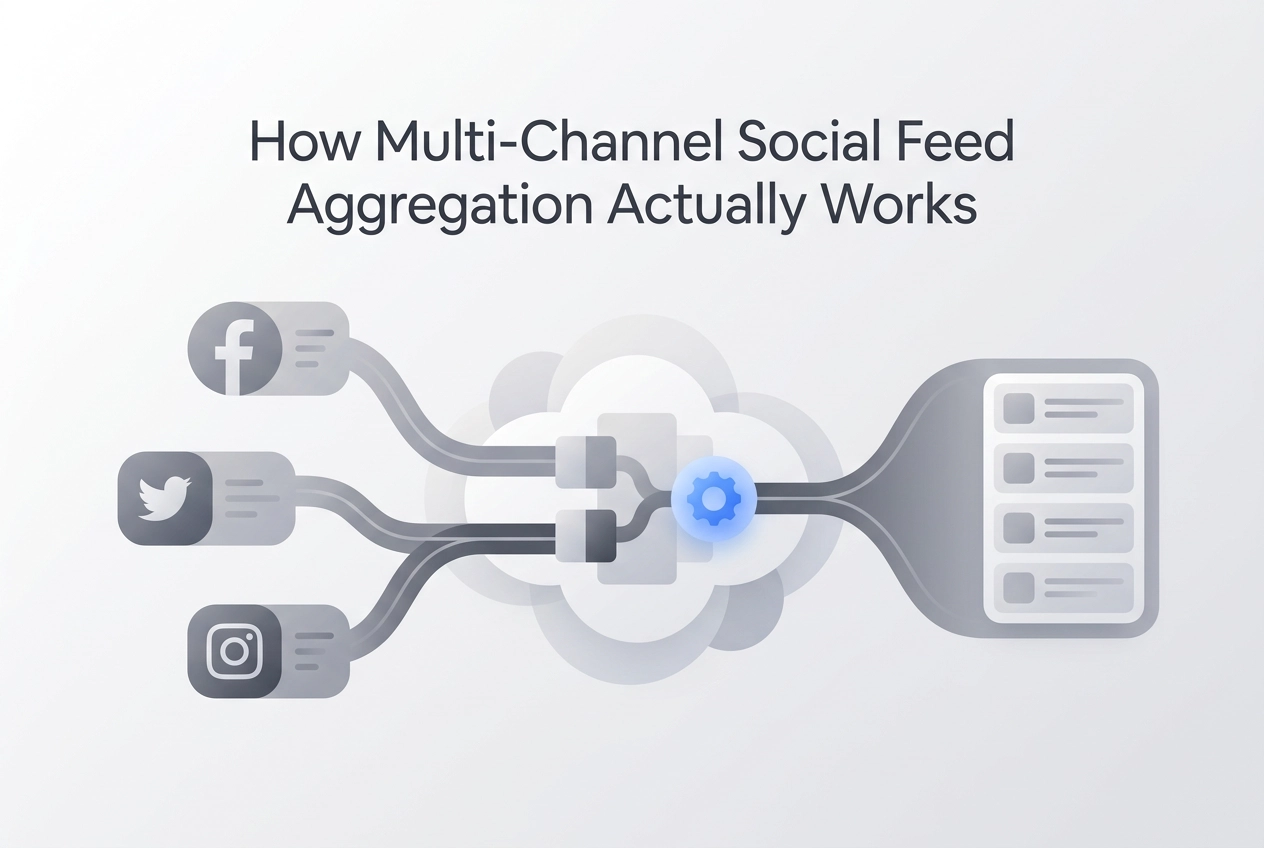
A single feed that pulls in posts from every social media platform you care about looks simple. It is not. What you see on the page is a rendering layer sitting in front of several independent pipelines, each with its own authorisation flow, quota system, and failure modes. Understanding how those pipelines actually work explains why pricing varies between providers, why some channels lag behind others, and what tends to break first when a platform changes its rules.
This analysis unpacks the architecture behind multi-source aggregation. We will walk through per-platform authorisation, where each source needs its own credential set. We will examine the quotas and rate limits that meter your costs. Hashtag capture is a different retrieval problem from account-based pulling. De-duplication handles cases where the same post arrives through two routes. A shared moderation queue sorts posts from many content types. The rendering layer has to place video inside page designs that already exist. We will also cover why some channels update slower than others and what breaks when platform rules change. Who owns the credentials and compliance when an agency runs your feed? And what should you ask a vendor before committing? This post answers those questions.
Why a Single Website Feed Is Never a Single Pipeline
What you see is one designed feed on one page: the rendering layer. Underneath runs a chain of independent jobs, each capable of failing without visibly taking down the others. Each social media platform publishes its own developer terms, authorisation model and content rules, so a multi-channel wall is several integrations running at once, not one connector with extra inputs. Google's YouTube Data API documentation treats quota costs and compliance audits as separate guides from authorisation, a signal that metering and rule review are ongoing workstreams rather than one-time setup. This architecture explains three buyer observations: why pricing changes when you add a channel, why some channels look fresher than others, and why one platform's policy change can stall content across the whole page. SocialMatix merges Facebook, Instagram, YouTube and TikTok, plus accounts, hashtags and content types, into one designed feed, so these pipelines run in parallel behind a single embed to unify your multi-channel social presence into one cohesive feed. That distinction shapes every layer described next.
Per-Platform Authorisation: One Credential Set per Source
Authorisation is per source, not per platform. Each integration needs its own app registration, client ID and secret, plus a permission grant from the account or page owner. Google's YouTube documentation splits authorisation into server-side, client-side, installed and device flows, each with different steps; no shared sign-in path exists. Tokens expire, rotate and get revoked, so stored refresh handling and a reconnection prompt are mandatory. Without them, one channel silently stops updating while the rest of the wall looks healthy. Scopes matter too: reading a page's own posts is not permission to search a hashtag, so adding tag capture may require a fresh grant. Count connected accounts, not platforms: four Instagram accounts and three Facebook pages are seven authorisations and seven failure points. This is why multi-platform merging is an integration exercise, not a single connector. Authorisation gets a channel connected; metering decides how often it can refresh.
Quotas and Rate Limits: The Metering Layer That Sets Your Cost
Authorisation gets a channel connected; metering decides how often it can speak. Platform APIs draw on a resettable allowance, and endpoints are weighted, so a heavy video lookup consumes more than a lightweight text fetch. Google treats this as a first-class concept, publishing a dedicated guide on determining YouTube Data API quota cost beside its compliance audit guidance.
Rate limits are a second, independent meter: a call ceiling within a fixed window, which governs how fast polling can realistically run. Together they drive per-channel cost. A frequently polled, expensive endpoint eats far more allowance than a slow account feed, so identical-looking walls can carry very different running costs. That difference belongs in your pricing and packaging for social feed services. It also explains throttling: near the ceiling, refresh intervals stretch rather than fail loudly, and the wall simply looks stale.
Hashtag Capture Is a Different Retrieval Problem
Where quotas meter how often you can ask, hashtag capture changes what you are asking. An account feed poses a narrow question: what did this profile publish? A hashtag capture poses a far broader one: who, anywhere on the platform, used this tag recently. Those are different endpoints with different permissions and limits. On major platforms, hashtag endpoints typically require business or creator context and carry their own constraints, making tag capture a pipeline of its own rather than a filter layered over account feeds.
Volume is unpredictable. A trending tag can return far more items in an hour than a steady brand account, straining de-duplication and moderation. It also pulls in unknown authors and media from people you have never dealt with, so pre-moderation matters more here than on owned channels. If a vendor quotes one price, ask whether hashtags are included as sources; they alter the retrieval, moderation and quota profile of the whole wall. This is one reason common types of social media feeds vary so much in running cost.
De-Duplication: When the Same Post Arrives by Two Routes
That broader retrieval surface is where duplicates start. A post can arrive twice: once because its author is an account you follow, once because it carried a captured hashtag. It must render once, or the wall looks broken even when every pipeline worked. Matching needs a stable per-platform identifier plus fallback checks on media address and text, since identifiers are not comparable across APIs. Edits, carousels and reposts create near-duplicates: strict identifier matching misses them, loose text matching over-merges distinct posts, so this is tuning, not a switch. De-duplication sits after capture and before moderation, so a twice-caught item would be reviewed and counted twice. When you systematically collect UGC across channels, ask how account-plus-hashtag overlaps are resolved; it is the commonest cause of visible repeats.
The Shared Moderation Queue: One Inbox, Many Content Types
De-duplication thins the queue; moderation still has to interpret what remains. A shared queue is one working inbox, yet items arrive from different social media platforms with mismatched metadata, captions, languages and media types. Reviewers need context per item, not a flat list. Approving or hiding is a state change that must reach the rendering layer on the next render, keeping queue and display in conversation. Volume is uneven: a hashtag campaign can multiply pending items overnight while an owned account feed stays flat, so reviewer capacity should scale with campaigns rather than average days. Agencies running one queue across client walls need clear separation so each client's items and decisions stay with that client. Auto-updating feeds still require human judgement at the boundary: platform acceptable-content rules and brand rules are different lists, and only one is written for you. Establish content moderation best practices before volume arrives.
The Rendering Layer: Fitting Video Into a Page That Already Exists
Once an item clears moderation, the rendering layer takes over, and it has the hardest job in the chain: placing content from several platforms into a page design that already exists without breaking layout, site speed or existing styles. Aspect ratios do not agree. TikTok and short-form YouTube are vertical, Instagram mixes square, portrait and landscape, and Facebook may return text or a link preview, so the grid needs a normalisation step before display. Video is not simply returned by an API. Player, poster frame, autoplay behaviour and a fallback are separate concerns, plus lazy loading so the rest of the page still loads quickly. Third-party hosting restrictions and visitor consent can decide whether a clip plays at all, so the layer needs graceful degradation rather than a blank grey box. As these platform-specific SMO tips for Instagram, TikTok, YouTube and Facebook show, formats keep shifting. The design is not decoration; it is the layer most likely to need rework when media formats, embed behaviour or consent expectations change.
Why Some Channels Update Slower Than Others
Even with the rendering layer settled, visible freshness still varies by source. Update speed is not a single setting: it reflects polling interval, allowance consumed per poll, and how long the platform caches a post before it is API-reachable. Light endpoints with generous allowances refresh often. Hashtag capture and video-heavy sources usually sit further back in the rotation, since each check costs more and returns more to process. Because rate limits and scheduled allowance resets draw on a shared pool, a burst on one source can slow the others until it replenishes. Moderation is a fourth variable: retrieval can take seconds while approval waits in the queue, so apparent platform latency is often queueing time. Ask which layers are configurable and how refresh frequency choices trade against allowance, because interval is usually a cost decision, not a technical limit.
What Breaks First When a Platform Changes Its Rules
If update speed already varies by layer, rule changes disturb those layers in sequence rather than simultaneously. Authorisation is the most fragile. A permission or scope change can invalidate every connected token at once, so each account owner must reconnect before content flows again. Metering changes come next: re-costed endpoints or tighter rate limits slow a channel before they stop it, and the first symptom is usually a wall refreshing less often, not going dark. Compliance is an ongoing workstream, not a launch task; Google's YouTube Data API documentation lists quota and compliance audits as a guide separate from its authorisation guides, which reflects continuing rule review after go-live. The rendering layer fails last and gets fixed last, because embed behaviour and visitor consent requirements can change what plays without returning any API error to monitoring. A vendor's maintenance workflow therefore matters more than its feature list: most post-launch failures are platform decisions, not product bugs.
Who Owns the Credentials and the Compliance When an Agency Runs the Feed
The same fragility applies to ownership. When an agency runs a client's feed, someone must hold the app credentials and access tokens, and that party is responsible for keeping them valid and within platform rules. Settle in writing whose developer accounts are used, what happens to the feed at contract end, and who re-authorises after revocation or expiry. Access disappears through ordinary events: a client revokes permissions, an administrator leaves, or a page changes ownership. The pipeline stops however well the tool is built. Compliance responsibility ultimately sits with whoever publishes on the website, so agencies should state who reviews items, who records decisions, and who answers a platform or regulator. Buyers should treat this as part of the pipeline cost, not an administrative afterthought.
What to Ask a Social Wall Vendor Before You Commit
Responsibility settles who is accountable. Capability determines whether the feed stays live. Put these to any vendor:
Sources: Which social media platforms and content types can sit in one feed simultaneously, and are hashtag captures first-class sources alongside accounts?
Authorisation: When a token expires, a password changes or a client revokes access, does the feed recover unprompted or does it need a support ticket?
Refresh behaviour: As a channel nears its rate limits, does refresh stretch silently? Can you configure the polling interval or must you accept the default?
Moderation: How does the shared queue behave during a volume spike, and can agency client walls be kept genuinely separate?
Rendering: How are the design and video player updated when a platform changes media formats, embed behaviour or consent expectations?
Answers to these reveal the pipelines behind the page.
Conclusion: Buy Pipelines, Not a Single Feed
The vendor questions above matter because what you are pricing is not access to social media platforms but a set of pipelines. Budget by source: each connected account, hashtag capture and content type adds authorisation, metering and moderation load, so a five-source wall and a fifteen-source wall carry genuinely different running costs. Before the feature list, ask for the maintenance workflow: token refresh, quota monitoring and rule-change tracking are what keep a wall live a year after launch. During your trial, force a real spike with a hashtag campaign rather than a quiet owned account, and watch the queue and rendering layer under load. If you are an agency publishing on a client site, settle credential ownership and compliance responsibility in the agreement now, not at renewal.